Literary Marais
The grand and elegant home of a famous designer
An article that explains the monthly expenses of a high-end apartment in Paris
Many clients often ask us about the cost of owning an apartment in Paris. Roughly speaking, there are four major expenses for holding an apartment: the expenses required for the operation of the apartment itself (property sharing costs, electricity and Internet fees, insurance, cleaning and maintenance costs for the interior of the apartment), major construction costs of the building, and taxes (land tax, residence tax, property wealth tax), and some other expenses (apartment rental management fee, butler service fee).
Today, we will take a high-end apartment of 100 square meters and a value of 2 million euros in the Saint-Germain district of the Left Bank as an example to explain in detail what the daily maintenance of the apartment will cost (do not confuse it with the cost of buying an apartment Oh).
01/ The cost of running the apartment itself
AARIANE
PARIS


Overseas Buyer Guide › Costs & Taxes › Holding Costs
AAriane · Paris
2026/06
Owning a Paris Apartment — Annual Holding Costs for Self-Use
For overseas buyers, one of the most important questions is not only how much it costs to buy a Paris apartment, but how much it costs to keep it each year. Acquisition costs are one-off; holding costs are recurring. For a 100 m² second-home apartment in central Paris, annual fixed holding costs typically range from €16,000 to €27,000, depending on the building, tax profile, occupancy pattern, and whether IFI applies.
This page focuses on self-use / second-home ownership, rather than rental operations. It is intended as a practical reference for €2M+ apartments in central Paris.
I. What annual holding costs include
For a non-rented apartment in Paris, annual holding costs generally fall into five categories:
-
Co-ownership charges
-
Local property taxes
-
Home insurance
-
Utilities and communications
-
Wealth tax and exceptional works, where applicable
Some costs are predictable; others are building-specific or event-driven. This is why reviewing the building’s recent minutes and maintenance history before purchase is as important as reviewing the apartment itself.
II. Co-ownership charges (Charges de copropriété)
Co-ownership charges are paid by apartment owners, usually quarterly, to the building manager (syndic). They cover common-area cleaning, lift maintenance, caretaker costs, shared insurance, and, in some buildings, collective heating.
Typical range in Paris: €40–€80 / m² / year
Indicative annual range for a 100 m² apartment: €3,000–€8,000
Main drivers include:
-
Presence of a concierge or live-in caretaker
-
Lift maintenance and insurance
-
Collective heating systems such as CPCU
-
Age, style, and upkeep level of the building, especially in Haussmann buildings
In practice, a building with concierge service, lift, and collective heating will sit at the higher end of the range.
III. Local property taxes
1. Property tax (Taxe foncière)
Property tax is payable by the owner every year, whether the apartment is owner-occupied or rented. It is based on the cadastral rental value and local tax rates.
Indicative Paris reference: €20–€40 / m² / year
Indicative annual range for a 100 m² apartment: €2,000–€4,000
Important note: Paris increased property tax sharply in 2023, and owners should always request the seller’s latest tax bill instead of relying solely on generic estimates.
2. Residence tax (Taxe d’habitation)
Residence tax has been abolished for main residences, but it still applies to most secondary residences. For overseas buyers, a Paris pied-à-terre is generally treated as a second home for tax purposes.
Indicative annual range for a 100 m² second home: €1,500–€3,000
If the property remains vacant for an extended period, additional vacancy-related taxes may also apply depending on the facts.
IV. Home insurance
Two types of insurance are commonly relevant for Paris apartments:

Premiums can be higher for ground-floor or top-floor apartments due to water intrusion and burglary risk. Borrower insurance linked to a mortgage is separate and should not be confused with apartment insurance.
V. Extraordinary works and building reserve funds
Under French co-ownership rules, many buildings must contribute to a reserve fund for future works. In addition, the co-owners’ general assembly can vote major repairs such as façade renovation, lift replacement, roof work, or pipe renewal.
These costs are not fully predictable and may amount to several tens of thousands of euros, depending on the building and your ownership share.
Before buying, it is essential to review:
-
The last three years of general assembly minutes
-
The current reserve-fund position
-
Any approved or proposed major works
For high-end apartments, this point is often more financially important than marginal differences in annual utility bills.
VI. Utilities and communications
1. Internet and telecom
High-speed fibre internet in Paris generally costs around €30–€40 per month, often including basic television channels. Premium channel packages can increase the monthly budget.
Indicative annual range: €400–€500 for a standard package
2. Electricity
Electricity costs vary substantially depending on the heating system and the apartment’s energy performance. In many older Paris buildings, heating is collective or gas-based and partly embedded in co-ownership charges. In renovated or more modern apartments, electric heating and hot water can materially increase the annual budget.
Indicative annual range for a fully electric 100 m² apartment: €1,800–€2,400
Where air conditioning is installed, summer electricity costs can rise further. Reviewing the DPE energy report before purchase is essential.
3. Security systems (optional)
A monitored alarm or telesurveillance service usually costs around €300–€500 per year, depending on provider and system complexity.
VII. Cleaning and interior upkeep
Regular cleaning and light maintenance are often underestimated by overseas owners.
Indicative references:
-
Declared domestic help via CESU: around €15–€20 net / hour
-
Through a cleaning company including charges: around €22–€28 / hour
-
A 100 m² apartment generally requires around 3 hours per session
For light interior upkeep, repainting and small repairs can be budgeted at approximately 0.5% of property value per year as a broad rule of thumb, though refined apartments with high ceilings, mouldings, and premium materials often exceed this level.
VIII. Annual cost snapshot (100 m² second home in central Paris)
Indicative annual holding costs


This total excludes major works, cleaning, interior maintenance, and mortgage-related costs. In buildings with collective heating, part of the winter energy cost is already embedded in the co-ownership charges.
IFI rate schedule (for reference)

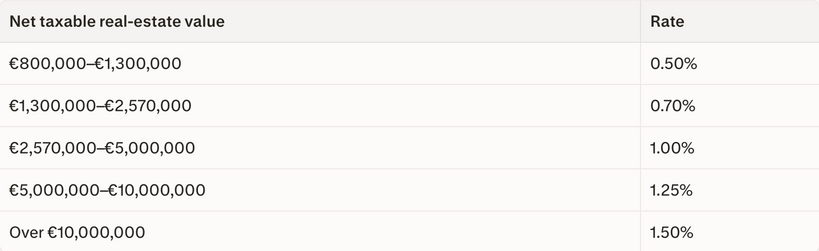
IFI applies above the statutory threshold on the net taxable value of French real-estate assets, after deducting eligible debt where applicable.
IX. Decision framework
For self-use buyers, annual holding costs should be treated as part of the acquisition decision from the start.
As a practical rule:
-
A buyer focused on long-term family use should pay close attention to building charges, reserve funds, and future works.
-
A buyer using the apartment only occasionally should focus on second-home taxes, security, insurance, and remote maintenance.
-
A buyer using leverage should integrate annual running costs with debt service and IFI deductibility.
-
A buyer comparing direct ownership with SCI structures should model holding costs together with IFI and exit taxation, not in isolation.
The headline acquisition cost is only the entry ticket; the holding profile determines whether the asset remains comfortable to own over time.
X. Frequently asked questions
Q1. Do I still pay tax if I own a Paris apartment but do not live in it permanently?
Yes. Property tax remains payable whether or not the apartment is occupied, and second homes are generally still subject to residence tax.
Q2. Are annual holding costs in Paris considered high?
For prime owner-occupied property, Paris is generally considered moderate by comparison with some other global cities, but taxes, charges, and IFI can still create a meaningful five-figure annual budget at the €2M+ level.
Q3. What is included in co-ownership charges, and what remains separate?
Co-ownership charges usually cover common-area maintenance, lift servicing, caretaker costs, shared insurance, and sometimes heating. They do not normally cover the owner’s private electricity, private insurance, or interior decoration and renovation.
Q4. Can major repair costs be predicted in advance?
Only partly. Reviewing recent general-assembly minutes helps identify planned works, but some repairs remain unpredictable, which is why reserve funds and building history matter so much.
Q5. Does IFI form part of annual holding costs?
For buyers above the threshold, yes. IFI is an annual tax on net taxable French real-estate wealth and should be included in the long-term budget model, especially for second-home ownership.
Q6. Where should I read about acquisition costs and ownership structures?
AAriane’s Buying property in Paris — acquisition costs and ownership structure guide explains one-time purchase costs, financing-related fees, and the tax logic of direct ownership versus SCI structures.
Sources: French tax law in force 2025–2026; IFI brackets per article 977 CGI (impots.gouv.fr); Paris property-tax rate per the City of Paris (paris.fr). Structuring decisions depend on individual tax, inheritance and legal circumstances.
This guide is framework-level information and does not constitute legal or tax advice. Always consult a French-practising notary and tax adviser before any decision.
→ Companion guide: Buying in Paris — Acquisition Costs & Ownership Structure